Tuesday, April 22, 2014

If God is Real - Why Can't I See Him?


Probably one of the most frequent objections to the existence of God is the fact that He can't be seen.  This objection takes many forms.  Sometimes it comes in the way of a fist, shaken at the heavens, calling upon the Unseen to just do something and make Himself known.  Other times in comes through the weeping frustration of unanswered prayers. 

But the underlying concern being raised is ultimately the same:  If God is real, why doesn't He just say so. 

Both believers and unbelievers dismiss the objection that He somehow "can't" do this.  The very notion of God implies an omnipotence that surely allows for self-disclosure.  He has done so in the past, according to the Biblical record.  So why not now? 

Sometimes we Christians respond with answers like this:  "But He HAS shown Himself.  Look at Creation, look at the Bible, and see His ultimate revelation in His Son Jesus Christ."  These responses are true enough.  But I don't think they usually satisfy the objector.  The soul that raises this question is looking for something more.  The painting proves there is a painter.  But we still like to meet and learn about the painter directly if possible. 

My own answer to this question has changed over the years.  I have now come to look at it in a different way.

Why doesn't God just SHOW Himself in some miraculous but undeniable way?

I think the answer begins with recognizing that God likes different things than we do.  Bear with me.  Have you ever met someone with an odd collection of trinkets?  You aren't quite sure what they see in them, but clearly they just adore them and keep looking for more to add to their collection.  Maybe their interest in these things seems utterly unreasonable.  But for that person, they are everything.

Now, if another human being could delight in something strange, surely God Himself might have something He delights in that we can't totally understand.  His nature is different.  His perspective is different.  He's been around a bit longer. 

When I look at what the Bible says about God, I discover there is something He loves that I don't fully comprehend.  That thing is faith.  To me, the concept of faith is a bit obscure.  It is not an attribute that enters into my daily routine too often.  I prefer evidence.  But this God of the Bible, though no enemy of evidence, expresses much more delight in this thing He calls faith.

And lo and behold, when I look at the world He has designed and His method of disclosing Himself, it is this "faith" that appears to be what He is looking for.  He has, according to His own wisdom, scattered throughout our world enough evidence of His existence to make faith reasonable.  But at the same time, has NOT disclosed Himself so much as to make faith unnecessary. 

We may argue that this arrangement isn't suited well to our natures.  But that only suggests that maybe our natures are in need of some work.  To say there is not enough "evidence" for me to believe sort of misses the point.  The faith that God delights in rests upon the clues and then trusts Him for the rest. 

And when you think about it, this isn't so far-fetched.  We do it, to some degree, every day.  We see the evidence that thousands have eaten at a particular restaurant and lived.  So we take it on faith we will live too.  The elevator held up the last batch of travelers.  We trust it will do so for us. 

Have you seen the clues?  Then don't ask for more evidence.  Doing so would only weaken the very thing God loves to see in us:  faith in Himself and in His Son Jesus Christ.  There is more to the story than this.  There is more to being a Christian than believing in the existence of God.  But a story needs to start somewhere, and there is a starting line to every race.  And this faith, that God loves, prepares the way. 


Sunday, September 22, 2013

To Live is Christ - George Swinnock on the Advantages of Holiness

"Oh the gain of godliness, the profit of piety!  Surely the price of this pearl is scarce known in the world!"

-George Swinnock 

We're living in days that have more counterfeit currency circulating as true Christianity than ever before.  And typically it is only this counterfeit form that the world ever sees.  Thus they conclude, and we can hardly blame them, that all Christianity is a fraud.  Maybe that is what you have concluded too.  You watch the way "so called" Christians live and you hardly notice a difference between them and those who claim no such spiritual investments. 
 
We are often told in Christian circles that there are really only 2 types of people in the world:  the saved and the unsaved.  In a sense, that is very true.  But in another sense it misses the mark, and fails appreciate another way of looking at things.  This other approach matches more closely with what the Word of God says in its warning about false piety and counterfeit Christianity. 
 
I prefer to say there are 3 types of people in the world.  There are (1) the double-losers, the (2) half losers and (3) the double winners.
 

The Double Losers

False Christians, who are merely professors of religion, but who have no real heart for Christ, are double losers.  They lose this life by failing to take advantage of its (albeit temporary) joys and pleasures, and they lose the next life because they never were truly born again.  They denied themselves here - but to no avail.  What did all their church-going and do-gooding profit them in the end?  They are self-deceived and the most to be pitied.  They have lost it all.  They have thrown away the only chance at pleasure they will ever have and gained eternal unhappiness as well.  If ever there were souls to be sorry for, it is them.
 

The Half Losers

Unbelievers, atheists, agnostics are half losers.  By "half" we don't mean that strictly speaking of course.  A few short years compared to eternity is hardly half.  But when considered in terms of our only two possible lives, this one and the next, they have lost half.  They have operated on the assumption that this life is all there is, and have therefore sought to maximize their own happiness here.  There are various ways this is done.  Some do so by living lives they consider virtuous, and other by living lives most regard as vile.  But in both cases they have sought their own happiness and have done their best to achieve it.  They will, of course, sadly inherit eternal misery, just as the first group.  But they will have had their pleasure here. 


The Double Winners

And this brings me to the topic of George Swinnock (1627-1673) treatise entitled "Heaven and Hell Epitomized."  It is from Volume 3 of his published works.  His text is Paul's words "for me to live is Christ and die is gain."  The great theme is to point out that the Christian man or woman has the best of both worlds.  He argues extensively and conclusively that Christians are winners in life and winners in death. 
 
What I found particularly refreshing were his words in chapter 19 which begins "motives to encourage thee to a laborious endeavoring after it [i.e. the 'spiritual' or 'holy' life]."  He reminds Christians of their present advantages which exceed the advantages even of those who are living only for pleasure.  He shows by logical argument that the Christian life is the most honorable, most comfortable and ultimately the most profitable life. 
 
We're prone to forget this.  It is easy to see the difficulties and miss the delights.  We focus on the pain, and we forget the promises.  He quotes Luther who  said "If I had my wish I would choose the homely work of a rustical Christian before all the victories of Alexander the Great and Julius Caesar." 


Conclusion

I confess I often don't live this way.  Too often my focus is merely upon the gains to come, and upon the sacrifices presently endured.  I've missed the "to live is Christ" and only considered the "to die is gain.
 
"To live is Christ" does not mean the Christian becomes a stoic, immune to and ignorant of the true sorrows and pains of this life.  It does mean that he or she sees them differently.  Yes, he suffers.  Yes, she suffers.  But they suffer as sons or daughters of the King.  They suffer not upon the shifting sands of fate or luck, but upon the solid promises of Jesus Christ.  To live is truly Christ. 
 
That's how I want to live.  God grant the grace to see our lives this way.
 
And for those who have drawn their conclusions about Christianity only from its imposters, I commend you to look to God's Word for yourself.  You wouldn't want to be judged based upon the behavior of someone else who happened to share your name.  Don't judge the truthfulness of Christianity merely on the basis of its professors.  Read the Bible.  See what it says.  Then determine for yourself if what it says is true, that "godliness...is gain."   


Sunday, September 8, 2013

5 Reasons For Slow Obedience to Christ

This morning I was reading in 2 Chronicles 24.  The chapter begins by praising the life and obedience of Joash, king of Judah.  Well, sort of.  The commendation heaped upon him comes with a hint of foreshadowing.  It said that Joash "did what was right in the sight of the Lord all the days of Jehoida the priest."  That last part is suggestive of a future decline, which in fact occurs toward the end of the chapter.  Sometimes our godliness is only the product of our company, not the result of true grace.  

But the words from the chapter that caught my eye today were the words concerning the priests whom Joash commanded to gather a collection and repair the house of the Lord.  He told them what to do, concluding with this express direction to "see that you do it quickly."

The very next verse begins, "however the Levites did not do it quickly."

Why not?  The text actually doesn't say.  It simply goes on to say that Joash brought the Levites in, reprimanded them, and sent them back to do the work which they then proceeded to do.  

But I wonder about their initial delay.  I wonder because I see in my own heart that sinful inclination to be sinfully slow in response to the Lord's command.  Why is this?  What is at the heart of delayed-obedience?  We tell our kids "to delay, is to disobey."  That is true.  But why is it that we are often so terribly slow to make the changes in our lives that the Lord clearly sets forth in His Word?

Here, I think, are 5 reasons:

1)  The fear of man.  

The Bible says that the "fear of man brings a snare (Proverbs 29:25)."  Maybe the Levites were afraid that the people would reject or revolt against their request for an offering to repair the house of God.  Maybe you and I are afraid what radical obedience will mean in terms of our relationships with friends or family.  We worry what others might think.  We worry what they might say.  And so, in spite of Christ's clear call upon us to do this or that, we delay.  We "do not do it quickly."  

2)  The love of sin.  

We delay because we are loathe to give up the very sin that God commands us to kill.  We know it is sin. We know it displeases the Lord.  But it provides a certain amount of pleasure in our life that we are unwilling to utterly forsake.  So we are slow.  We don't hate sin as we should.  The Psalmist says "All you who love the Lord, hate evil (Psalm 97:10)."  But because we refuse to view sin from the Lord's perspective, we "do not do it quickly."

3)  Excuses.  

Another reason for our delayed obedience is that we excuse or justify our delay on the basis of our circumstances or situation.  We may think "yes, this thing is wrong, and does not belong in my life....BUT right now my situation is unique and therefore I cannot do it just yet."  This, I believe, is our most subtle weapon against obedience to Christ.  We are masters of "exceptions."  Like the Pharisees we can see the splinter in the eye of another, but we ignore and excuse the plank in our own.  It is helpful to remember that no excuse will stand on judgment day when "every mouth will be stopped."  

4)  Imagination.  

Our imagination is a wonderful gift.  It has produced creative solutions to countless problems.  Einstein called imagination the "preview of life's coming attractions."  But imagination can work against us too.  Let me explain.  We can easily be tempted to imagine a "tomorrow" in which we are being obedient to the Lord. We can see clearly to that day in which our life and God's Word align.  All the pieces have fallen into place. The situation is perfect.  And we are happily doing what God requires.  Some day.  Just not yet.  Not today at least.  The problem with this is that God doesn't want our imagined obedience He wants our immediate obedience.  The author of Hebrews, quoting the Psalms, says "TODAY if you will hear His voice, do not harden your hearts...(Heb 3:15)."

5)  An insufficient love of Christ.  

Here is the root of all delays in dealing with our sins.  We do not love Jesus Christ enough.  To quote Jesus Himself, "the love of many will grow cold (Matthew 24:12)."  We have not spent sufficient time contemplating His great love for us.  We have not stirred up our affections with the thoughts of His beauty and grace.  We have filled our hearts with worthless and temporary things, rather than the immeasurable glory and majesty of the King of Kings.  We need to hear the words of Christ to Peter, "do you love Me?"  And with weeping and repentant tears we need to confess our lack of love to Him "who loved us, and gave Himself for us."

Conclusion:

These, I believe, are the reasons we delay and are slow to obey the Lord.  The good news is that NONE of them needs to continue a moment longer.  Not one.  Nothing but our own sin stands between us and immediate obedience to Jesus Christ.  The Levites "did not do it quickly."  But upon hearing the rebuke of Joash, they made a change.  So can you.  The result, in their case, was to "restore the house of God to its original condition and reinforced it (2 Chronicles 24:13)."  That is precisely what God is up to in the Christian's life.  He is restoring us into HIS image, and the image of His Son.  By His grace it can be done and will be done.  For He "who has begun a good work in you will complete until the day of Jesus Christ (Philippians 1:6)."  


Sunday, May 5, 2013

Forsaking All - Thoughts from Luke 14:33

True Biblical Christianity is an all or nothing deal.  And this is why it is so rare.  Scores are willing to sample religion in the way one samples wine.  But few are willing to invest their whole life in contents of a single bottle.  We prefer to hedge our bets.  We play it safe.  We will invest only so much, but never dare to put all our chips on the table of Jesus Christ.

But the true Christian has no other option.  Jesus put it this way "whoever of you does not forsake all that he has cannot be My disciple (Luke 14:33)."

Those are hard words.  What does it mean to forsake all?  Honestly, I've been wondering about that for myself.  It is so easy to get tied up in the things of this life.  So easy to allow the weeds of worry to strangle out any spiritual life and contentment we might enjoy.  As a busy pharmacist, husband and father of 4 (3 of whom are teenagers now - yeah - pray for me!) it seems so hard not to be consumed by the business of life. 

I don't believe Jesus was telling all His disciples to sell all their goods and own nothing.  Anyone aware of Biblical history both before and after Christ recognizes that is not what the Lord plans for most of His followers.  There were rich Christians and poor Christians.  And in spite of what some may think based upon the often misquoted verse from Scripture, it is not "money" that is the root of all evil, but rather the "love of money" that God condemns.

A look at the context of the Luke 14 statement helps me grapple with this issue.  Jesus is talking about the "cost" of discipleship.  He reminds His hearers that you love your family best by putting Him first.  That's what He meant by a disciple "hating" his "father and mother, wife and children, brothers and sisters."  To "forsake all" with respect to my family means that my relationship with Jesus cannot be separated from my relationship with them.  He is also talking about "bearing" the cross to be a Christian.  In Biblical terminology this does not mean simply carrying a heavy burden   To "bear the cross" was to prepare to die.  The cross was an instrument of execution.  The true Biblical Christian, in a sense, must die to the things of this world.  He/she can't be caught up in them any longer.  Jesus is saying you can't go half-way with this.  Like the person who builds a tower or plans a war - you best be prepared to finish what you start.

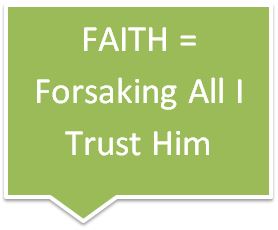
The idea of "forsaking all" is something I need to keep examining myself about.  How about you?  How much time and energy do I invest in things that ultimately won't matter?  Someone once defined "F.A.I.T.H." this way:  Forsaking All I Trust Him.  I think that gets to the heart of the matter.  Am I putting my trust in myself, my connections, my bank account, my skills....or am I ultimately putting my trust in Jesus Christ?  That, it seems to, is what "forsaking all" is all about.  And it is comforting to know that He who calls us to forsake all, will never forsake us.  "For He Himself has said, I will never leave you nor forsake you (Hebrews 13:5)."


Sunday, February 10, 2013

Completely Clean


Image: Courtesy of news.legalexaminer.com
 
 
"He who is bathed needs only to wash his feet, but is completely clean."
John 13:10


You know the story.  Jesus washed His disciples feet.  Peter objected.  When Christ explained it was necessary, Peter again tried to trump our Lord's direction with his own agenda, saying "Lord, not my feet only, but also my hands and my head!"

I like Peter.  There is so much in him that is typical of our own hearts - my own especially.  Jesus' words and instructions were simple.  Peter insisted on complicating them.  That tends to be our way.  Take a very simple statement of Scripture, and find a hundred ways to "un-say" what it obviously says or implies.  We try to make the words of God fit with our own perspective of right & wrong, rather than humbly asking the Lord to give us faith to trust Him.  Every page of the Bible is, in some sense, God saying "Jason - do it My way." But Jason too often has his own plan, his own agenda, his own goals.  We put "our feelings" before "God's instruction." 

What struck me in Jesus' words today illustrates this.  He spoke of being "completely clean."  Jesus is speaking spiritually.  This is no surprise to readers of John's gospel who have heard Christ speak using earthly words to convey spiritual realities such as the "new birth" and "living water" and "the food which endures to everlasting life."  Completely clean means being completely "clean" spiritually and legally before the throne of God the Judge.  Sin and guilt , over and over in Scripture, is illustrated by uncleanness.  Unforgiven is unclean.  Unforgiven is like coming up from the mud and never being able to wash it off.  Unforgiven is like perpetually living with the black marks of the coal mine of our sinful hearts.

Jesus is speaking to Christians.  He is talking of those who have already "bathed."  In other words, they have already been born again.  They have already been united to Christ.  They have already been once-for-all washed in the blood of the Jesus which "cleanses us from all sin."  But such Christians still need - in addition to this - a daily sense of and appreciation of forgiveness through repentance.  Sin is still a part of my life, and my sin still stains and smudges my Christian walk.  My conscience is stained.  My witness is stained.  My fellowship with the Lord is stained. 

What Jesus is saying is that the daily "foot washing" of repentance makes us really, truly and "completely clean." 

Christian - when you ask the Lord to forgive your daily transgressions - you are completely clean.  Completely.    That's what Jesus said.  "He who is bathed needs only to wash his feet, but is completely clean."  But like Peter, far too often we are slow to believe it.  Guilt builds up.  An awareness of inadequacy weighs us down.  Guilt is not the problem.  It is our [my] unwillingness to repent and believe in forgiveness that is the real culprit here. 

Jesus cleanses us daily when we confess our sins.  And this is a pattern for our service to others.  The daily cleansing we receive at Christ's hands provides us the example of the daily service and love we are to show one another. 

Completely clean.  It feels good.  But it takes faith to believe it.