Saturday, October 17, 2009

Immanuel Chapel joins the Orthodox Presbyterian Church

Immanuel Chapel becomes Immanuel Chapel OPC


At 8:30PM on Friday October 16, 2009 as Pastor Mark Marquis closed the reception service with these words “The grace of the Lord Jesus Christ, and the love of God, and the fellowship of the Holy Spirit be with you all” Immanuel Chapel of Upton, MA was officially and formally received as a particular congregation of the Orthodox Presbyterian Church. This evening was the culmination of at least 2 years and 8 months worth of prayer, study, and discussion related to the topic of Biblical Church Government. I provide here an extract from the minutes of our session meeting of February 10, 2007:

“VII. It was decided unanimously that we would call a Congregational Meeting on February 28, 2007 to open up the question about church government for discussion. The purpose of the meeting is to determine if the congregation would be willing to consider Presbyterianism as an alternative to our present form of Cambridge Platform Congregationalism.”

This decision by the session was prompted by a series of prior discussions and concerns over matters such as mission’s oversight, ordination practices, and membership matters that were seen to be complicated especially by our form of government. Immanuel was founded and established as a Congregational church in the Reformed Tradition expressed in such documents as the Cambridge Platform and Savoy Declaration of Faith. This heritage, though rich and in many ways Biblical, had left Immanuel virtually independent in the regular exercises of the government and ministry of the church. And so, under the gracious and guiding hand of God and for His glory, this body of believers began in early 2007 a sort of wilderness journey together which brought us to the evening of October 16, 2009 and our reception into the OPC.

The reception service actually began at 6:40PM with a meeting of representatives from the OPC Presbytery of New York and New England in the basement classroom of Immanuel Chapel. The representatives were:

· Pastor David O’Leary – Pastor of First Presbyterian OPC church of Ipswich, MA
· Pastor Stephen Migotsky – Pastor of Jaffrey Presbyterian church in Jaffrey, NH
· Pastor Richard Dickinson – Ordained minister of the OPC and full time military chaplain
· Pastor Allen Tomlinson – Ordained OPC minister and pastor of First Congregational Church of Merrimack, NH
· Pastor Greg Reynolds – Dr. Reynolds is Pastor of Amoskeag Presbyterian Church in Manchester, NH

The meeting was opened in prayer and the representatives of the Presbytery approved the order of the service which was to follow. It was discussed and agreed that the session of Immanuel Chapel could, on the basis of this reception service tonight, accept into OPC membership all those members currently on the rolls of the church, even those who for various reasons could not attend the reception service that evening.

The reception service began officially at 7:00PM and in attendance was, along with the members of Immanuel Chapel, various visitors and friends who shared with us in the joyful events of the evening. After a word of welcome from Pastor O’Leary, former Immanuel Chapel Pastor, Leonard Gulstrom (who served Immanuel from 1995-1999), was invited to open the reception service in prayer.

Following this the congregation sang a favorite Psalm together, Psalter selection 98A. The words were fitting for the occasion as the Psalmist says “Oh, sing a new song to the Lord, for He has done marvelous things.” Indeed, what we were doing and seeing this night was nothing less than a “marvelous thing” in the history of Immanuel Chapel.

Following this Psalm Pastor Migotsky read to the congregation Philippians 3:1-16. Following which Pastor Dickinson preached the Word to those gathered. This passage encouraged believers to build all their hope and lives firmly upon the person of Jesus Christ. “I count all things loss for the excellence of the knowledge of Christ Jesus my Lord (vs. 8).” Pastor Dickinson solemnly reminded us that Christ must remain central to our life as a church. We are joining the OPC, but the OPC did not die for Immanuel Chapel…Christ did. He warned us about looking elsewhere for guidance. The world around us is changing. We are changing. But Jesus Christ never changes. He is the same “yesterday, today, and forever.” Come to Him! Keep coming to Him. And in Him, he reminded us, we will find all the fulfillment, fellowship and satisfaction that our hearts long for.

After his message, Pastor Mark Marquis read a moving and thoughtful letter to Immanuel Chapel from our former Pastor, Irfon Hughes (who served Immanuel from 1983-1993), who could not be with us that evening. In it he said that he had felt long ago that the OPC was the best place for Immanuel, and was so pleased that the Lord had guided us in His timing to this place.

Pastor Allen Tomlinson reviewed for those present the process that had been followed by the Presbytery in receiving Immanuel Chapel, including the examinations of officers and meetings with the congregation.

Pastor Greg Reynolds then proceeded to ask the members of Immanuel Chapel to rise and respond to the 4 vows of membership as found in the OPC book of church order. Following these Pastor Reynolds issued a charge to the congregation, especially focusing on the much neglected subject of the “Biblical importance of church membership.” After this, Pastor O’Leary officially welcomed in the members of Immanuel chapel to the OPC. He then proceeded to ask the elders and deacons to come forward and take the vows of office as prescribed by the OPC.

An audio clip of these vows is included here:


Following this Pastor Mark Marquis was called forward and asked to take such pastoral vows as is in accordance with the recommendations of the OPC.

These vows being taken Pastor O’Leary gave a charge to the officers of Immanuel Chapel drawing specifically from 2 Timothy 4:5 “Be watchful in all things.” He pointed out that one modern translation says “keep your head in all situations.” When things seem to be falling apart, “keep you head.” When tragedy strikes, when problems arise, when confusion threatens to overtake the church…”keep your head.” Be watchful of each other. Be watchful of yourself. And remember, he told us, the Lord Himself is watching you.

At this point the founding pastor of Immanuel Chapel, Norman Brower, came to the front and shared some of his own personal joy and love for this congregation which he began serving in 1975. He pointed out that Immanuel is actually the 3rd church that he planted which has eventually joined the OPC! He then offered a prayer to the Lord for this church and her officers.

The concluding hymn, “For all the saints,” was then sung together. Pastor Mark Marquis closed the meeting with a benediction, and Immanuel Chapel officially became the newest congregation in the Orthodox Presbyterian Church.

What spiritual lessons can be gleaned from this process? What has the Lord done at Immanuel Chapel? How can we apply something of this history to our own souls? If ‘history’ is “His Story” then what does this brief portion of our history tell us of the wonderful works of Jesus Christ in His church?

1) Jesus Christ is the Head of the church. Let us never forget this. What happened here in this process was not our work but Christ’s work. The moment we begin to think of the church as “our church” is the very moment things begin to go wrong. There are so many little things that happened and that coordinated in making this transition possible that only God Himself can be credited with the glory. Oh my soul, remember this truth, and do not be discouraged when difficult days draw near. Christ still is the Head of His church.

2) Jesus Christ often drives His church into uncomfortable and unfamiliar places to strengthen our faith in Him. There was no real blueprint for this process. But this body of believers was convinced that the Lord is glorified when churches work together in tangible unity, fellowship, purity, accountability and service for the glory of Jesus Christ. The Lord called this little flock of believers to step out of the comfortable boat and walk to Him on the water. I can confess personally that I often, like poor Peter, found myself sinking and looking around at the waves. But He who began this work, would also complete it.

3) In Christ are all the provisions needed by His church. Many helped us through this process. But all who did were ultimately doing so as the arms, hands, and mouth of Christ Himself. Paul wrote to the Colossians and said “you are complete in Him.” Elsewhere he, speaking of Christ, writes of “the exceeding greatness of His power (Eph 1:19).”

4) Finally, all such who see Christ’s work in His church should submit and accept the provision of forgiveness as offered in the gospel. What other response is rational dear reader? If Christ is so working and moving and orchestrating His church…what shall become of your soul if you continue to resist and refuse to surrender to the call of the gospel? “Who then is able to stand against Me” (Job 41:10) says the Lord. Shall you? Will you overthrow the advancing of His kingdom when Christ Himself said that “the gates of Hell shall not prevail against it?” Oh my friend, you who possess a soul that lives here for a moment and must forever enjoy or regret the decision you now make, please “be reconciled to God.” Turn from your sin today. You have run up a great debt of iniquity in heaven’s account. “But there is forgiveness” with the Lord, that He may be feared (Psalm 130:4). Repent and believe the gospel today. May this little history of the work of Christ at Immanuel be the beginning of God’s work in your soul!


We welcome you to come and visit us at Immanuel Chapel Orthodox Presbyterian Church.

To God be the Glory!


I wish to express our heartfelt appreciation to all the men named above, as well as others, who were instrumental in so many ways related to our joining the OPC.
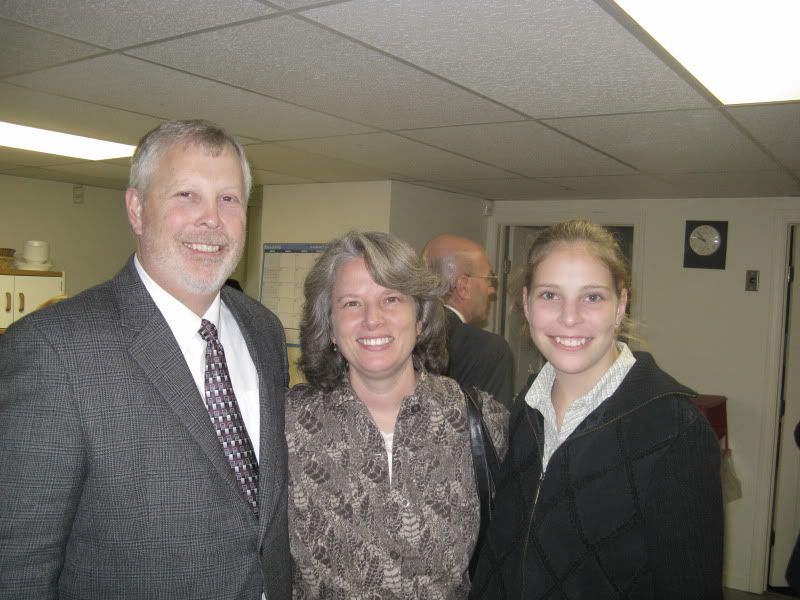
A few pics:

Pastor & Mrs. O'Leary from Ipswich, MA OPC


Pastor Richard Dickinson and our own Pastor Mark Marquis


Founding Pastor and Mrs. Norman Brower


Pastor and Mrs. Leonard Gulstrom with their daughter


Monday, September 21, 2009

Eyes See You

“For the eyes of the Lord run to and fro throughout the whole earth, to show Himself strong on behalf of those whose heart is loyal to Him.”
2 Chron. 16:9


Removed from its context our Scripture might simply be seen as a pleasant promise, a pithy proverb, an encouraging epithet, a refreshing reminder, or a soothing slogan intended to strengthen the souls of faithful but struggling saints. We see a watchful Lord, whose eyes “run to and fro.” We see a powerful defender who will “show Himself strong.” And we see the nature of true child of God revealed: “whose heart is loyal to Him.” All of this looks encouraging, helpful and hopeful. All these things are true, and one could assemble no small sum of evidence to support these statements from Scripture.

The problem with these observations, however, is that left alone they all entirely miss the point of the passage. It is easy for those who spend time reading and studying the Bible to grow lazy. We look at a verse, come up with a few helpful things to say, and think we have gotten to the heart of it. Our text becomes nothing more than a simple slice of bread in our sermon sandwich, which we then proceed to cover with any number of Delicious Doctrines and Covenant Cold Cuts plucked from the indolent ice box of our own imaginations. I fear that much teaching and preaching that goes on today is guilty of this sin. It is not enough to tell the truth when handling Scripture. It is not enough to steer clear of gross error when handling the Word of God. Faithful stewards of heavenly mysteries will not settle for sound doctrine alone, but aim for the truth or doctrine of that particular text as his target to shoot for. In other words, it is possible to be right, and still in some sense, be wrong. Souls can be ruined just as easily by misplaced truths as outright heresy. To put it in the words of the Puritan William Ames "Ministers impose upon their hearers and altogether forget themselves when they propound a certain text in the beginning at the start of the sermon and then speak many things about or simply by occasion of the text but for the most part draw nothing out of the text itself."

These things being said, what seems to be the point of our passage? I cannot pretend to plumb its depths. Every verse of God’s Word is a virtual ocean of instruction which the sails of our understanding can never entirely explore. But I would humbly suggest that there are at least two central ideas which must not be missed in the words of our text today. First, these words are essentially a rebuke. And second, they are a rebuke that is aimed at the church. Allow me a few moments then to explain and apply these words to our souls.

Every Christian finds himself or herself in the midst of various trying and troubling times. We are, in many ways, always walking in the midst of the fiery furnace of affliction. And these afflictions come in many forms. “Outside were conflicts; inside were fears (2 Cor. 7:5).” They may be physical afflictions such as pain, disease, abuse, illness, persecution, or wants of any number of necessities. They may be mental afflictions such as worries and stress and pressure and fear. Some men’s afflictions are more outward and obvious, and other men’s afflictions are more hidden and unknown which often makes the bearing of them more difficult. And always, along with these afflictions, comes along a particular temptation, a sin, and an opportunity to escape the burden of the trial with the indulgence of some iniquity. Abraham was childless, but there was a Haggar at hand to relieve his remorse. Jonah was discontent with his commission, and a ship for Joppa was there to enable his escape. Along side every rough road, Satan has sown the soft grass of sin as a remedy for relief if only we are willing to disobey the Lord.

So it was for King Asa of Judah. His country was under siege by Baasha king of Israel. Baasha had blocked off all traffic to and from the city. Oh how many souls have felt this very affliction of being cut off from others, loved ones, friends, family, yeah even outside the observation of God Himself! “For I said in my haste, ‘I am cut off from Your eyes’ (Psalm 31:22).” Asa was trapped and he saw no escape. But then he remembered the sinful nation of Syria. There were treasures enough in the house of the Lord to purchase the protection of this foreign power. “Then Asa brought silver and gold from the treasuries of the house of the Lord and of the king’s house, and sent to Ben-Hadad king of Syria…” (2 Chron. 16:2). And although this sinful treaty brought some relief from Baasha, it brought a stern rebuke from the Lord.

Asa acted as though he were abandoned by God. Thus the Lord sends His prophet to chasten his lack of faith with these words. Asa acted as though God couldn’t see, and thus ran to Syria for support. “In this you have done foolishly” said the Lord, for “the eyes of the Lord run to and fro throughout the whole earth.” Asa thought God was far and Syria was near. Dear reader, are you tempted to think that the Lord does not know about your present distress? Are you choosing transgression to rid you of your trouble, rather than trusting in the strength of our God? What is that burden or affliction that you have been escaping by indulging in sin rather than coming to Christ? Can it not be said of us, as it was said to Asa: “In this you have done foolishly?” May this gentle rebuke stir us up to repent and return to a Savior who will indeed “show Himself strong on behalf of those whose heart is loyal to Him.”

Not only are these words a rebuke, but it should be carefully considered that this is a rebuke of the church, that is, of believers. It is a rebuke aimed at Christians, and not at the world. Asa, you see, was a good man. This is the testimony of the Scriptures, not merely the opinion of a person. 2 Chronicles 14:2 says “Asa did what was good and right in the eyes of the Lord…” and 15:17 says “Asa’s heart was loyal to the Lord all his days.” Men with good hearts sometimes make foolish choices. A child may be a true son, but still sometimes transgress the will of his father. Israel and Syria had no small sin in this circumstance. But it was to Judah that the Lord sent this word of judgment, it was the church the Lord chastised. Dear Christian reader, and you oh my soul, receive these words as they are rightly intended. Let us repent of our sins by which we seek to ease our sufferings. Let us turn from our transgressions by which we try to escape our trouble. Is your heart wounded by these words? Know that such warnings come from the hand of a heavenly Father who only disciplines those whom He loves. Call upon Christ to show Himself strong when your soul is weakened by affliction. He will, for “His strength is made perfect in weakness.” Oh burdened brother or sister, do not trade away a loyal heart at any price! That gratification which costs you your conscience is Hell’s currency, it is fool’s gold. Disobedience is always a downward spiral. Asa failed to trust the Lord, but rather than repenting he took out his anger on the prophet “and put him in prison” and upon the people of God: “and Asa oppressed some of the people at that time” (2 Chron. 16:10). He became sick, but still he “did not seek the Lord (2 Chron. 16:11).” Here is a sad case of a withered soul. Dear reader, you possess an eternal soul, so let these words ring in our ears a clear warning of the dangers of disobedience.

Let me conclude with some words of application and encouragement to Christians who are under the pressure of Asa’s situation, but do not want to commit Asa’s sin. The temptation to escape your burden by way of sin is pressing hard down upon you. There seems to be no escape. Upon you is a trial unbearable and before you a sin unthinkable. Often before perhaps have you sold the temple gold of a good conscience to buy help from the fleeting pleasures of sin. What can you do now?

First, consider that help from the Lord is much closer than it presently appears. “The eyes of the Lord run to and fro throughout the whole earth.” This is to say, as it were, that help is near. “The Lord knows the ways of the righteous (Psalm 1:6).” Your way may be a hard way, an oppressed way, a trying way, a painful way, a lonely way, a humiliating way, a troubled way…but it is not a hidden way. “There is no creature hidden from His sight (Heb. 4:13).” A man alone in the ocean will give up hope if he sees no help. But if he should see land, no matter how far it may seem, he will be encouraged to swim and struggle and press on for his eyes can see his help is near. The eyes of the Lord are on you, and so the help of the Lord is near you. Dear suffering soul, look to the Lord, for His eyes are always upon you.

Second, consider that God Himself is glorified in helping His children who cry to Him. It is precisely in such circumstances as you now stand that the Lord’s strength can be most fully displayed. He shall “show Himself strong.” It was when no escape seemed obvious to Israel, that Moses could say to the people by the sea “stand still, and see the salvation of the Lord (Exodus 14:13).” The Apostle Paul discovered the strength of the Lord during his times of greatest personal distress and weakness, for Christ said to Him “My strength is made perfect in weakness.” Set your heart and mind upon the glory of God displayed in your own deliverance right now, and you will find this saying true that “He is their strength in time of trouble (Psalm 37:39).”

Third, the sin solution always costs more in the end. Asa thought deliverance would only cost him a little gold. In the end it cost him his conscience, his kingdom, and his life. “The way of the transgressor is hard.” To trade away suffering for sin is always a bad bargain.
Finally, remember that Christ alone can meet the deepest need of troubled hearts. A “loyal heart” is nothing but a heart that has been surrendered to Jesus Christ. Have you done so? Oh suffering soul…have you looked to Jesus Christ for rest and peace and hope? Or are you still trying to deliver yourself from all your troubles? The Lord is looking for loyal hearts. “Some trust in chariots, and some in horses; but we will remember the name of the Lord our God (Psalm 20:7).”

Wednesday, September 2, 2009

Withstanding the Kingdom

“And now you think to withstand the kingdom of the Lord….”
II Chron. 13:8a


The words of my text and the words I shall write are addressed to you who have not yet surrendered to Jesus Christ. They are the words of a king of Judah addressed to a rebelling king of Israel, but if you permit me, I would like to address them to your soul. You may be a close friend of mine, a neighbor, a loved one, a co-worker, a church going person, an acquaintance or even a stranger. Today my heart is deeply impressed with your greatest need, which is an uncompromising and immediate surrender to God. My heart goes out to you, not chiefly because we cannot share this faith and enjoy mutual converse in the things of the Lord…though this would delight me very much. My heart goes out to you because you are engaged in a battle you will not win. “You think to withstand the kingdom of the Lord.”

Every soul on earth belongs to a kingdom, and there are but two in the entire world. There may be any number of countries and nationalities, hundreds of languages, and thousands of districts, and cities, and villages. There are many rulers scattered all over the world and many different forms of government established to organize and protect their citizens. But there are only two kingdoms. You belong to one or the other. These kingdoms are as different as two kingdoms can be. They have different kings, different standards, and different destinies. The Bible calls the one “the kingdom of the Lord” (II Chron. 3:8) and the “kingdom of heaven” (Matt. 3:2) and the “kingdom of His Son” (Col. 1:13). The other is simply the “kingdom of Satan” (Luke 11:18).

My purpose I will not conceal. I have but one reason for writing to you this day. My whole heart and mind are focused upon one single goal. I wish to persuade you to leave the kingdom you are in and submit to the kingdom of God. I am asking you to change your allegiance, your commitments, your citizenship, and your status. I am pleading with you to think about where you are now and where you are going and to change directions. I have laid my cards on the table before you. I do not want your money, your property, your influence or your talents. I want you to give your heart to Jesus Christ.

Your life has had numerous blessings. Times of unexpected prosperity, times of undeserved pleasures, times of love and laughter and plenty. You have experienced, at times, the kindness of others. You have had food enough, and sometimes enjoyed meals so delicious the flavors and savor are permanently impressed upon your mind. You have read something moving, and your heart was lifted. Sweet music has moved your soul, lightened your mood, and soothed your mind. All these good things God has provided for you to enjoy. And yet, for all that, “you think to withstand the kingdom of the Lord.” You have hardened your heart against His tender calls to repent and believe. Oh my dear friend, do you not see that you “despise the riches of His goodness…not knowing the goodness of God leads you to repentance? (Romans 2:4)”

Your life has had troubles. Your plans have been overturned, your advantages been lost, and your health at times has been taken away. You have known the pains of lost love, the sorrows and fears of being alone, you have known times of being in want and a deep sense of emptiness that nothing in this world you have found can fill. Injustice has troubled you, unkindness has followed you, and unmerciful enemies have dealt unfairly with you. All these and more the Lord has allowed so that you might turn to Him in the day of trouble, and yet “you think to withstand the kingdom of the Lord.” Oh that you would this very day turn to Jesus Christ and find in Him a “refuge in the day of trouble” (Psalm 59:16) and a “very present help in trouble (Psalm 46:1).”

Your sins have been a web entangling your own soul in sorrow. Temptation comes and you find not the strength to resist, though you know this sin will only bring more pain and problems upon you. Your own conscience cries out against you for the wrongs you have done, the hurt you have caused, the weakness of your flesh, and the failure of all your resolves. Attempts to deliver yourself from greed and envy and anger and lust and pride have all been unsuccessful at last. And you have heard of this gospel by which men may be forgiven their sins and have peace with God. You have heard there is a merciful Lord who takes pity and has said “I will forgive their iniquity, and their sins I will remember know more (Jer. 31:34).” You have heard it said by Jesus “I have power on earth to forgive sins” (Matt. 9:6) and that “we have redemption through His blood, the forgiveness of sins (Col. 1:14).” But alas, even still, “you think to withstand the kingdom of the Lord.”

I too belonged to that kingdom in which you now stand. I understand your hesitation and your fears and your arguments against surrendering to Christ. But I plead with you, before time runs out, to be reconciled to God (2 Cor. 5:20). I shall lay before you briefly four more arguments to abandon your kingdom of sin, and self and Satan and come over by faith to the kingdom of Christ.


First, your resistance is Unreasonable. Why should you continue to refuse God’s gift of His Son? Much lesser gifts have you received in this life, from much lesser persons, and these you received with gladness and gratitude and much joy. But you refuse God’s gift of eternal life? Is that reasonable? You accept eagerly gifts that cannot last. But you will not receive the “gift of righteousness” (Romans 5:17) that lasts forever?


Second, this is Unmerciful. Should you not have mercy on your own soul? Will you sentence your own soul to everlasting punishment simply because you will not humble yourself to repent and believe? Is it merciful to exchange a few moments of pleasure for an eternity of pain? Thomas Manton once wrote “A man's greatest care should be for that place where he dwelleth longest; therefore eternity should be his scope.”


Third, your efforts to withstand the kingdom of the Lord will be Unsuccessful. Abijah, king of Judah, cried out to the armies of the enemy in our text and said “O children of Israel, do not fight against the Lord God of your fathers, for you shall not prosper!” (2 Chron. 13:12) Oh my dear friend, whoever you are, you shall not prosper in this fight which you maintain. Surrender. Give all to Christ. Lay down your arms. Hear His gracious invitation “As I live,’ says the Lord God,  ‘I have no pleasure in the death of the wicked, but that the wicked  turn from his way and live. Turn, turn from your evil ways! For why should you die, O house of Israel?” (Ezekiel 33:11)

Finally, dear friend, your withstanding is utterly Unnecessary. There is no good reason for it at all. You lack no invitation, for you have been invited to come by the gospel itself. You lack not the means, for this offer is given freely “without money and without price” (Isaiah 55:1). You lack not the opportunity, for “behold now is the accepted time, behold, now is the day of salvation (2 Cor. 6:2).” You lack no promise of success for Jesus Himself declared “the one who comes to Me I will by no means cast out (John 6:37).” Oh why, why, why do you then delay?
Why go on withstanding the kingdom of the Lord?

Monday, August 31, 2009

Prepared To Die

“So David made abundant preparations before his death.”
I Chron. 22:5


PREPARED TO DIE


What does it mean to be prepared to die? Is it to have ones finances in order, to have a good name with family and friends, to have an inheritance ready to bestow upon ones posterity, or the making of some great mark upon the landscape of history? When is a man or woman truly prepared to die? In our text we find a wise old king making preparations before his death. There was a glorious temple to be built, and although David was not to build it himself, he set about doing all that he could to make it ready for Solomon his son. David knew himself to be a mortal man. He was not deluded with thought of immortality, a common disease amongst the children of men. He knew himself to be no exception to the rule that it is “given unto man once to die” (Heb 9:27) and “what man can live and not see death (Psalm 89:48).”

David now lived fully aware that this day of death was marching toward him. Maybe he remembered times when he was young and was not so wise. Maybe he could recall times when he thought himself above the law of God and beyond the reach of death. Like when he was eager to number the armies of Israel but not careful to number his days. Like when he stole a wife and took a life, but never pondered that one day his own life would be required of him. But such is the grace of God that He grants repentance and today David was a different man. The preparations he was making now were clearly and decidedly “before his death.” His end was on his mind. He knew the silver cord of his life would one day be loosed (Eccl. 12:6). As he said to Solomon in another place “I go the way of all the earth (1 Kings 2:2).”

I think our text tells us, therefore, some of the things that make a soul prepared to die. Let us examine the words in their context and see.


I. First, that soul is prepared to die that is taken up with and concerned most with the glory of God. David’s thoughts were not on his own comfort or even chiefly with his children’s comforts, but with the glory of God. “…the house to be built for the Lord must be exceedingly…glorious.” Oh my soul, is that your goal, your aim, your focus, and your whole heart’s desire? Are you thinking today about the glory of God and how He is to be exalted, worshipped and praised? What is there of God’s glory in your plans today? Should my life be required of me this night, shall I enter eternity knowing my mind was set on heaven all day?


Objection: But must I be all about God’s glory every day? May I not be ready for death, but still grant time to my own pursuits, my own interests, and my own pleasures? Are only those souls ready to die that are entirely focused upon the glory of God?


Answer: 1) First, who gives you breath every moment? Who sustains your life every hour? Who set the sun over your head by day, and the moon by night? What do you own that God has not granted you? By Whose providence are all the events and circumstances of your life directed and planned? If you can truly find one second of life which you can claim as your own, then you may use it as you like. But you cannot. Therefore that holy apostle writes “whether you eat or drink or whatever you do, do all for the glory of God (1 Cor. 10:31).”


2) Second, where you would go is entirely taken up with the glory of God. Shall you prepare for such a place by only giving God some glory now? Heaven’s song is “Blessing and honor and glory and power be to Him who sits on the throne, and to the Lamb forever and ever (Rev. 5:13).” How is that soul prepared for heaven that is content to give God but a little glory here on earth?

David made “abundant” preparations in our text. His heart was filled with the thoughts and wonders and delights of the glory of God, and this is how he spent his days before his death. Would you be prepared to die? Then fix your heart upon God’s glory. Consider what you may do to advance His kingdom. Adorn the gospel with good conduct.


II. Secondly, that soul is prepared for death that prefers the worship of God above all else. The temple to be built was a place of worship. There the songs would be sung and sacrifices offered. Thus this “house of the Lord God” is called “the altar of burnt offering for Israel” in this chapter (22:1). David’s final days were not spent extending the borders of his kingdom, enlarging the floor plan of his home, or increasing his own revenue, fortune or fame. He gave his thoughts over to preparations respecting the worship of God. He loved to worship the Lord.

What about you? Is that the bent of your soul this day? Have you met the Lord in private and worshipped Him? Do you look forward to times of public worship with the gathered people of God? Or are such times far from your heart and far from your thoughts? Do you allow every trivial matter to interfere with the worship of God in your life? Do you excuse your regular absence from God’s places of worship? This is nothing new. “But they all with one accord began to make excuses (Luke 14:18).” The problem is not your demanding schedule; the problem is a dead heart.


Question: How do I know if I cherish the worship of God above all else?


Answer: Do not look at man for your standard, for one can always find someone less Godly, less holy, less careful by which to satisfy your soul. Turn your eye upon God’s standard, and chiefly with the first four commandments of the moral law.


“You shall have no other God’s before Me.” That soul which cherishes the worship of God will seek to have no other “gods” in his or her life. God alone will be worshipped, God alone will be honored, and God alone will be feared. Take a careful inventory of your life dear reader. Who is your “god?” Where do you spend the majority of your energy and interest and time? Who has your heart?

“You shall not make for yourself any graven image.” That soul which cherishes the worship of God and is thus prepared for death is content to worship God in His way, with His means, and His commands. “The heart of man” said Calvin “is a factory of idols.” Do we think we are interested in worship because of our beads, our crosses, our statues? Or what about the idol of your favorite hobby, possession, loved one, family member, religious leader, church denomination, creed, or whatever. Your idol may be a good thing in itself, but it is an abomination in God’s eyes because you put it in the place that belongs to Christ alone. Listen, for example, to what Pastor John Angel James (1785-1859) said to his congregation “And how many parents need the simple exhortation of the old writer, "Beware of the little idols in white frocks." I would not have parental affection diminished…But then I would remind that mother, that she has a God to love, and serve, and please, as well as a child—a God that is in himself, and ought to be to her, infinitely more than that lovely son. And if all her thoughts, and feelings, and purposes, and aims, flow in one undivided current to that child, is he not her idol?”

“Do not take the name of the Lord your God in vain.” This commandment asks us this question: “how precious is the name of the Lord to our souls?” According to our text David loved the name of God. He said “it was in my mind to build a house to the name of the Lord my God.” Is God’s name precious to you? Does the abuse of His name, so frequent in our day, wound your spirit? Do you and I, who bear the name of Christ, behave so as to protect the glory of that name? When we play the hypocrite the world looks on, and as Paul said to the Jews in Rome, “the name of God is blasphemed among the Gentiles because of you (Romans 2:24).”

“Honor the Sabbath Day.” Here I must cry out against my own sin and the sin of my fellow believers in our day. This day of rest and the setting aside of worldly labor and entertainments has been so forgotten it is shameful. How can any soul claim to be prepared for his eternal rest that will not even try to keep the emblem of that day, the Lord’s Day, right now? We think we have done enough if we have submitted to an hour of public worship in a week. And then we, who claim to have our hearts fixed upon heaven, fill up our Lord’s Day with the world. We think our souls well fit for an eternity of rest in heaven, but should our preacher chide us for our Lord’s Day neglect we call him a legalist, a puritan, a preacher of “works righteousness” and so on. I do not wish to lay any burden on the people of God that does not flow from His law and His Word. But tell me dear ones, does your present practices on the Lord’s Day really flow from His Word…or from your own desires, plans, and interests? Is there not something wrong when we, who claim Christ is our all in all, our hope, our life, our everything…can only bear to engage our souls with Him one hour, and then off to the mall, the beach, the party, the movies, the shop, the yard, etc.?

All of this has been but a brief test upon our hearts, a little examination of our souls, about our love and longing for the worship of God. David would prepare for the temple before his death with diligence, labor, and passion. He said to Solomon “I have taken much trouble” (22:14) with respect to these preparations. Do you dear reader prepare for the Lord’s Day that way? If not, how do we think ourselves ready for heaven?

III. Thirdly, and lastly, our text teaches us that the soul has prepared itself well for death that is most concerned for the spread of the gospel of Jesus Christ. David was preparing for a temple, but that temple pointed to Jesus Christ. This temple signified the presence of God. But there has never been a dwelling place for God on earth like Jesus Christ. “In Him dwells the fullness of the Godhead bodily (Col. 1:19, 2:9, John 1:14).” To the temple the sacrificial lambs were brought. But Jesus Christ Himself is the “lamb of God that takes away the sin of the world (John 1:29).” David made many preparations for the temple, though it was but a shadow and type of He who was to come.

Dear reader, is your heart taken up with the glorious gospel of Jesus Christ? No soul is prepared for death that does not love the message of the gospel and seek to spread it everywhere they can. Who can you tell of Christ before you die? Your time, and mine, is running out. Now is the time to tell your neighbor, your loved one, your friend about all that Christ has done for you.


Oh my soul, and oh dear reader, let us live the boldest and fullest of lives, but let us live them moment by moment for our great Savior and with an eye to heaven. Let me close with the words of Richard Baxter: “Live as those that are going to the grave…spend every day in preparation for death; and in all your business remember, whither you are going and where you must dwell forever."

Sunday, August 30, 2009

The Thought of God

I find it interesting that Satan’s first assault on man’s soul was not actually intended to discredit the word of God but rather the character of God. He said to Eve “Has God indeed said, ‘You shall not eat of every tree of the garden?” His sinful suggestion was a serious slander aimed at their Creator. He was saying, as it were, “Has God put you in the midst of all these delicious fruit trees and then forbidden you from tasting even one? What sort of cruel and callous God is this you serve? Does He sit up there in heaven grinning with pleasure as His creatures are forced to famish in the midst of plenty?”

Our enemy knows he can trip man up more easily with a subtle attack upon the nature of God than a direct assault upon the Word of God. Oh my soul…what are your thoughts of God today? Dear struggling and suffering soul, what think ye of God? Dear tired and lonely soul, what think ye of God? Dear pressured and tempted soul, what think ye of God? Unworthy thoughts of God are the net that the Devil casts to catch souls under the trials and tribulations of life.

Was not this exactly the thinking of the man Jesus describes in the parable of the talents? He was given one talent and he buried it in the ground. When the master returned this miserable servant could only say “Lord, I knew you to be a hard man…” Oh my soul, and oh dear reader, is that your thought of God this day? Are you cherishing harsh thoughts of God? What a strange and sad irony that this servant was so quick to think harshly of his Lord, but so slow to think harshly of his own sin! Oh the deceitfulness of sin and the craftiness of Satan! God Himself is often tried and convicted in the courtroom of our mind, while our own disobedience passes by the judge of conscience without a word.

J.C. Ryle, the English clergyman, once wrote “Let us never allow ourselves to think harsh thoughts of God. Let us never suppose that He can give us anything that is not really for our good. Let us see in every sorrow and trouble of our earthly pilgrimage, the hand of Him who gave Christ to die for our sins.”[1] Dear Christian, let not your heart be troubled nor your soul saddened by severe thoughts toward your Savior. Hear God’s Word through the mouth of the prophet Jeremiah “For I know the thoughts I think toward you, says the Lord, thoughts of peace and not of evil, to give you a future and a hope.” (Jeremiah 29:11)

Our thoughts of God will often influence our thoughts of others also. The elder brother in Jesus’ parable of the prodigal son was sharp and sour toward his sinful sibling. But why? Jesus ends the parable with an insight that explains his hardened heart, and it was harsh thoughts toward his father. “These many years I have been serving you…and yet you never gave me a young goat, that I might make merry with my friends (Luke 15:20).” He saw himself as a slave, and his father a cruel master. Pastor and theologian Sinclair Ferguson once remarked in a sermon “we are to others, precisely what we believe God has been to us.”

What of you, my unbelieving friend, neighbor or distant reader? What thoughts of God have kept you from trusting in Him and turning from sin today? Do you think His service hard? Jesus said “Come unto Me all you who labor and are heavy laden, and I will give you rest.” Do you think His wages are unworthy? What of the wages you presently earn? “For the wages of sin is death. But the gift of God is eternal life through Jesus Christ our Lord.” Abandon every thought of God that comes not from His Word. “Let the wicked forsake his way, and the unrighteous man his thoughts; let him return to the Lord, and He will have mercy on him; and to our God, for He will abundantly pardon (Isaiah 55:7).”

[1] Old Paths, p. 386